


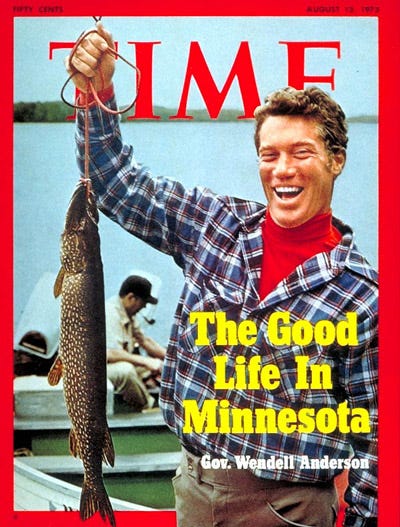
In 1973, TIME magazine published a now-infamous cover featuring a handsome man holding up a lake trout he’d caught. In the background: a pristine lake, a humble everyman in a small boat, and a gorgeous forest. The man in the foreground was Governor Wendell Anderson, a trailblazing social democrat seen by many as injecting glamour and vigor into the once-boring but stable state.
Minnesota wasn’t the only Midwestern state with socialist impulses and a heavy dose of modified Janteloven—what Americans called “Minnesota Nice.” Wisconsin, North Dakota, and Michigan also hosted large left-wing communities of Northern Germans and Scandinavians, electing politicians who promised comprehensive redistribution. What set Minnesota apart was its people’s high human capital, strong institutions, and deep interpersonal trust. Simply put, the average Minnesotan was slightly smarter and more capable than the average Michigander or Wisconsinite. And lest you think I’m just a racist eugenicist, know that I was one of Scott Walker’s biggest fans back in the day.
WENDELL ANDERSON AND THE CREATION OF A MIRACLE
Before Derek Thompson wrote a book on policy-induced abundance, his most compelling work was a 2015 series on America’s superstar cities. These top six hubs were drawing millions of the world’s most talented people, but unaffordable housing and high living costs hindered their potential. Millennials faced a choice: accept lower standards in big cities or relocate to second-tier ones. Minneapolis circa 2015 stood out as different.
Thompson attributed Minneapolis-St. Paul’s success to the state’s revenue-sharing system between rich and poor counties and aggressive affordable housing policies. This ensured decent funding and talent access, helping more students reach their potential. They grew into productive adults who built businesses and corporations, generating wealth for Minnesotans. This “Minnesota Miracle,” aided by luck, prevented the state from hollowing out like Illinois or Wisconsin. Unlike its neighbors, Minnesota’s economy outpaced the Midwest into the 2000s.
The foundation was a pioneering, communitarian, and often consensual political culture. Wendell Anderson, a doctrinaire progressive eyeing the White House, embodied a pragmatic tradition. His pragmatism and telegenic charm built temporary consensus for generous public services—and the taxes funding them.
The paradox behind the miracle
Minnesota couldn’t stay the “it” state forever. George Floyd’s death at the hands of a zealous police officer exposed the state’s secret shame: America’s social democracy was a tough place for Black residents. Competent administration and robust safety nets hadn’t transformed lives for its growing Black and Brown population. White Minnesotans fared better than
many elsewhere in America, while non-Whites, though better off than peers in other states, weren’t thriving.
Twenty-seven percent of Black Minnesotans lived in poverty, versus 6% of Whites. Seventy-two percent of Blacks graduated high school, compared to 89% of Whites. Seventy-seven percent of Whites owned homes, but only 29% of Blacks did.
Young progressives worldwide, enraged by this incident, questioned how an exemplary social democracy let a quarter of its citizens suffer.
Some blamed racism. Others cited cultural dysfunction. Most were outraged.
For five years, the state’s progressive elites have moved heaven and earth to address disparities for non-White residents. Yet gaps persist, and beneficiaries are souring on their benefactors. This discontent partly drives Minnesotans toward Republicans; without weak candidates and a mismanaged state party, Minnesota would be more purple than blue.
Conclusion
If you’re a hereditarian or don’t dismiss persistent individual and group differences, Minnesota’s struggles aren’t mysterious. Its success drew millions of less able, underprivileged people seeking better lives. These domestic and international migrants haven’t assimilated well, despite efforts from leaders and themselves.
It’s unclear if investments in reducing disparities will pay off. Until they do, the state that works will see its people victimized from within and without.